
Measuring the Total Light in the Universe
The extragalactic background light (EBL) is the accumulated radiation emitted by astronomical sources from the early universe to the present day. Measuring its brightness and spectrum allows us to investigate when and how extensively celestial objects formed, including sources too faint to be detected individually by conventional telescopes.
Light That Known Galaxies Cannot Fully Explain
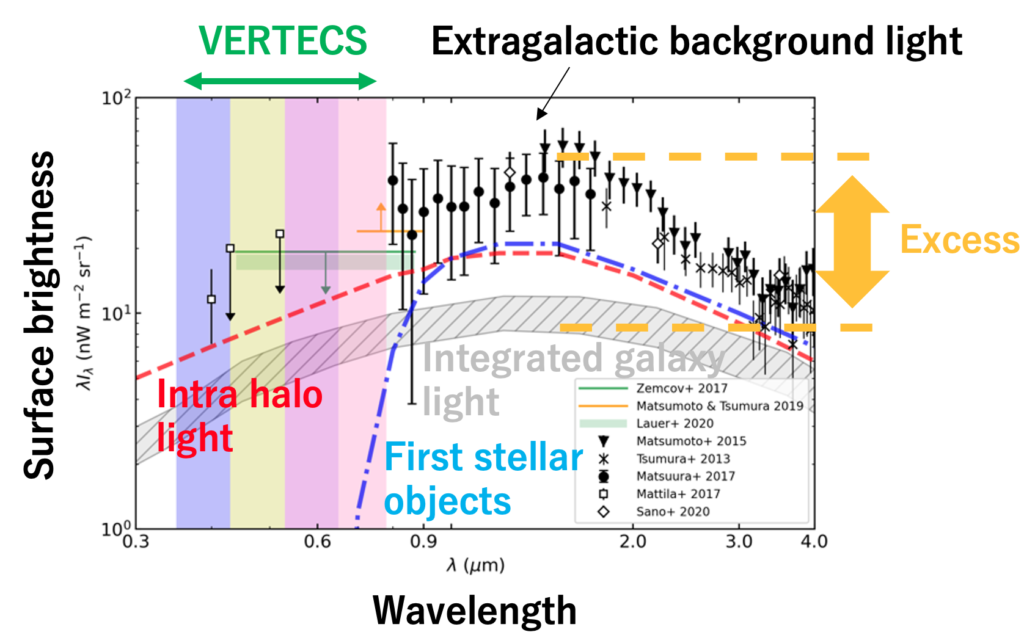
Previous observations have reported that the near-infrared EBL is approximately two to three times brighter than the integrated light of known galaxies. If this excess is real, it may indicate a population of sources too faint to be detected individually or a previously unidentified emission process.
Where Does the Excess Come From?
Possible origins include objects formed in the early universe, such as the first generations of stars, and faint stellar populations in the halos of relatively nearby galaxies. These candidates may produce similar near-infrared brightness, but they are expected to have different colors and spectra at visible wavelengths.
Why Observe in Multiple Visible Bands?
VERTECS observes the EBL in multiple visible wavelength bands. By measuring its spectrum from visible to near-infrared wavelengths and comparing it with candidate models, VERTECS aims to distinguish whether the excess originates in the early universe or in the more recent, nearby universe.
Why Observe from Space?
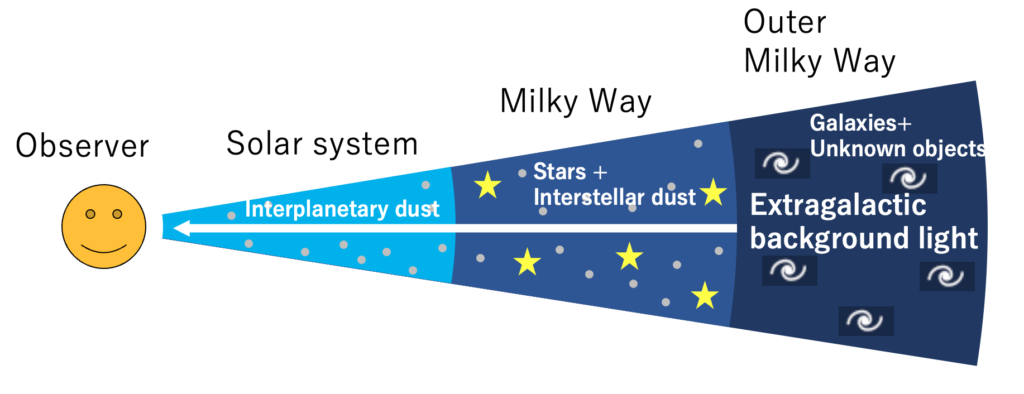
The EBL is extremely faint. Atmospheric emission, zodiacal light scattered by dust in the Solar System, and light from stars and dust in the Milky Way all contaminate the measurement. Observing wide areas from above Earth’s atmosphere and comparing data from different directions helps separate these foreground components from the EBL.
The Scientific Goal of VERTECS
VERTECS uses wide-field optics, a baffle designed to suppress stray light, and a low-dark-current CMOS sensor to measure the faint, diffuse EBL. By identifying the origin of its excess component, the mission seeks to reveal aspects of cosmic object-formation history that cannot be recovered from observations of known galaxies alone.